
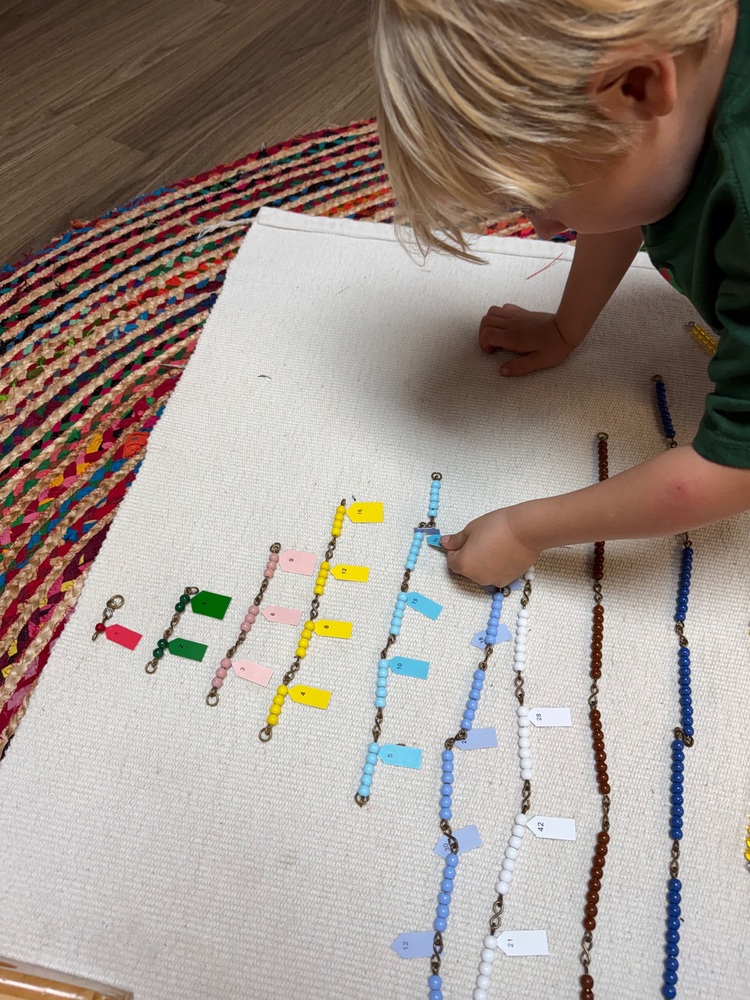
Many years ago, while I was still a professional musician and long before I became a mother, I heard the word Montessori for the very first time.
At the time, I was living in Bloomington, Indiana, playing in a rock band, and several of my musician friends were becoming parents. As their children approached toddler age, conversations naturally turned to education and where they would send their children to school. Bloomington Montessori was the place to be! It was a school where children were encouraged to be themselves, learn at their own pace, and grow in a supportive environment. Learning was not something that happened in short bursts throughout the day; it was a lifelong journey.
I remember thinking, Why in the world would anyone send their child anywhere else?
As someone who had always felt a little "different" from my peers growing up, I instinctively knew that I wanted my future children to attend a school where they would feel valued for who they were, develop confidence in themselves, and, most importantly, love learning.
Not too many years later, I became a mother, moved back to northern Indiana, and enrolled my daughter at The Montessori Academy. I have never looked back.
So, what does my personal Montessori journey have to do with accreditation?
Everything.
One of the challenges of Montessori education is that the name "Montessori" is not trademarked. Any school can call itself Montessori, regardless of whether it truly follows the educational philosophy and principles developed by Dr. Maria Montessori. Some schools embrace the name without fully embracing the practice. I recently heard a long-time Montessorian affectionately refer to these schools as "Montes-sortas" — schools that are sort of Montessori.
This is precisely why accreditation matters.
Accreditation is not simply a certificate to hang on the wall or a distinction to include in our school materials. It is a rigorous, multiyear process of reflection, evaluation, and accountability. It requires a school to examine every aspect of its operations, from classroom practices and student experiences to governance, finances, facilities, and community relationships.
In essence, a school going through accreditation writes its own story. It celebrates its strengths, acknowledges its challenges, and identifies opportunities for continued growth. Then, a team of experienced educators and school leaders visits the campus to verify that story, ask thoughtful questions, and ensure that the school's practices reflect its stated mission and values.
Accreditation asks us not simply to say that we are doing what is best for children, but to demonstrate it. It holds us accountable to our families, our faculty, our community, and, most importantly, our students.
The Montessori Academy has a long and proud history of this commitment. In fact, TMA was the second school in the country to earn accreditation through the American Montessori Society (AMS). Approximately twenty years later, we expanded that commitment by pursuing dual accreditation through AMS and the Independent Schools Association of the Central States (ISACS). Together, these organizations provide a comprehensive framework for evaluating both the authenticity of our Montessori practice and the overall health and effectiveness of our school.
Today, Sunday, November 8, we are excited to welcome seven volunteer accreditation team members to our campus: three representing AMS and four representing ISACS. Over the following several days, they will observe, listen, ask questions, review our work, and, ultimately, help us confirm the story we have spent years telling through our self-study.
After more than fifty years of serving children and families, we recognize that being an excellent school does not mean being a perfect school. It means being a school willing to look closely at itself, celebrate what is working, acknowledge what needs improvement, and continually strive to do better.
That is the true value of accreditation. It is not about proving that we have arrived. It is about demonstrating our commitment to continually growing, learning, and remaining accountable to the children and families who place their trust in us.
And really, isn't that what Montessori education is all about?